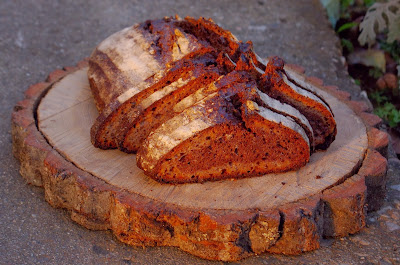
pane di Pasqua lituano / Lithuanian Easter bread

[cliccare il link per andare alla versione in italiano]

Lithuanian Easter Bread

the final rendition

Easter breads across Europe feature eggs (uova), probably the food most revered this time of the year. When I was a little girl, my aunt Lucia explained to me that hens laying eggs again after the sluggish winter months was cause for celebration. I agreed.

Yesterday, I saw several farmers selling eggs at the market, each having a nice pile of cartons on their table, a sign that the winter dearth of eggs is over.

As an avid egg consumer, I find myself with a lot of egg shells. I mostly use them in the garden, as snail and slug barrier:

Sweet Pea

sweet pea seedling needs protection

When I saw a recipe for Easter bread from Lithuania, the country we are currently visiting in our virtual European Community tour, the decision was quickly made to work on a personal version.

As usual, after identifying a recipe to use as inspiration, I went my own way, in terms of adjusting both the ingredients and the realization. The result makes no claim of being traditional, but it has been inspired by the tradition. 

I made the bread three times, testing a couple of variations and below is the recipe that produced my favorite version. 

Print-friendly version of briciole's recipe for Lithuanian Easter bread

Ingredients for the dough:

  1. 250 ml non-fat milk at 95 F / 35 C
  2. 2 tablespoons / 28 g unsalted butter, melted and cooled
  3. 3 large egg yolks from pastured poultry / 75 g
  4. 20 g fluid honey or agave nectar
  5. 1 teaspoon / 5 ml vanilla extract
  6. 4.5 g instant yeast
  7. 80 g whole-wheat flour
  8. 340 g King Arthur Flour all-purpose flour (this is the flour I always use to make bread)
  9. 3 g fine sea salt
  10. 1/2 cup / 70 g raisins (uvetta, see Notes below)

Ingredients for the egg wash:

  • 1 large egg yolk
  • 1 1/2 tablespoons / 22.5 ml water
  • 1/2 tablespoon poppy seeds (see Notes below)

Important: for this bread I use delayed fermentation, so the preparation starts the evening before baking.

Notes:

  1. White (a.k.a., golden) raisins are traditional, but I have organic flame raising and organic Thompson raisins at home, so I used those.
  2. I added poppy seeds as topping the third time I made the bread and it was a good choice — festive too. (As an aside, Lithuanian Christmas bread is topped with poppy seeds.)

Place the first five dough ingredients in a bowl. Whisk to break the yolks.

Add yeast and whisk a bit more.

Add the other dough ingredients to the bowl and stir until they come together into a shaggy dough. Cover the bowl and let rest for 10 minutes.

Stir dough for another minute. (If you use a wooden spoon, dampen it before stirring so the dough doesn't stick to it.)

Oil a clean bowl or dough-rising bucket and transfer dough into it. With damp hands pull the dough gently on one side and fold it over towards the opposite side, then do the same on the opposite side, as if you were folding a sheet of paper into thirds to put into an envelope. Since the dough is inside a bowl the result will not be a rectangle, but that is fine. Turn the folded dough upside-down, keeping it still inside the bowl. 

Cover the bowl with a clean shower cap or piece of plastic wrap. If you use a dough-rising bucket, put the lid on. Refrigerate the dough overnight.

The morning after, take the bowl or bucket out of the refrigerator. Line a 9" x 5" / 23 x 12.5 cm loaf pan with parchment paper and oil the two sides not covered by it. 

Empty the container onto a lightly floured surface. Gently flatten the dough into a longish rectangle. Fold the dough into thirds lengthwise, like a letter, then fold in half along the same direction and press the seam to close it tightly. Lightly roll to make a cylinder that fits the loaf pan. 

Transfer the rolled dough into the prepared pan, seam side down, cover with shower cap or plastic wrap and let rise at room temperature until doubled. How long it takes depends in part on the room temperature. (In my case, about 2 1/2 hours.) 

When the dough is almost ready, preheat the oven to 350 F / 177 C. If you have the convection bake option use it (and, if your oven does not do it automatically, adjust the temperature accordingly).

Whisk water into egg yolk for the wash. With a pastry brush, paint some egg wash on the surface of the dough. Sprinkle poppy seeds. (You will not use all of the egg wash: leftover can be added to a frittata; I also added it to puréed lentils to make patties.) 

Place bread pan in the oven and bake for 35-40 minutes. Check internal temperature. If it is 190 F / 88 C, the bread is done, otherwise continue baking until the internal temperature is reached. 

Take the loaf out of the pan and place it on a cooling rack.

When completely cooled, slice and enjoy.

Lithuanian Easter bread

first rendition (with plump flame raisins)

This is a lovely soft bread. My version is not very sweet — most of the sweetness comes from the raisins — and it goes well with either a sweet or savory companatico (literally: that which goes with bread), like roasted apple sauce, bresaola, homemade Colby cheese (to whose curds I add toasted hazelnuts). And it makes a great French toast.

image from 3.bp.blogspot.comI contribute my bread to the 22nd installment of the Abbecedario culinario della Comunità Europea (European Community Culinary ABC), an event organized by Trattoria MuVarA that will bring us to visit 26 countries of the EU (all except Italy) using the alphabet as guide. V like Vedarai (Lithuania) is hosted by of Angela of Mestolando.

On this page you will find the recipe for Vedarai and the list of recipes contributed to the event.


Nuovo italia (1)I am sending this bread to the April edition of Panissimo, a monthly event created by Barbara of Bread & Companatico and Sandra of Indovina chi viene a cena? and hosted this month by Barbara.

The roundup of the event.


Nowy2And also:

– to the monthly showcase Sourdough and Yeast by Wisla (in Polish). The roundup of the event.

– to Yeastspotting. This page contains part 1 of the roundup and a link to the other two parts. 


Click on the button to hear me pronounce the Italian words mentioned in the post:

pane di Pasqua lituano

or launch the pane di Pasqua lituano audio file [mp3].

[Depending on your set-up, the audio file will be played within the browser or by your mp3 player application. Please, contact me if you encounter any problems.]

[jump to Comments]

bread, Easter bread, egg, raisins, Lithuanian cuisine

Newrule

pane di Pasqua lituano

Lithuanian Easter Bread

l'edizione finale

Pani tradizionali di Pasqua in molte nazioni europee hanno come ingredienti le uova, probabilmente il cibo più celebrato in questo periodo dell'anno. Quando ero bambina mia zia Lucia mi spiegò che le galline ricominciano a deporre le uova dopo i lenti mesi invernali e questo è motivo di gioia. Concordo.

Ieri al farmers' market ho visto diversi tavoli con pile di cartoni, segno che la scarsità di uova fresche è finita.

Essendo un'avida consumatrice di uova, mi ritrovo con molti gusci e li utilizzo nel mio orticello come barriera per chiocciole e lumache:

Sweet Pea

la piantina di fiori di pisello va protetta

Quando ho visto una ricetta per pane di Pasqua della Lituania, il paese che stiamo visitando in questo periodo nell'ambito del nostro tour virtuale della Comunita Europea, ho deciso di realizzarne una versione personale.

Come al solito, dopo aver identificato una ricetta che mi ispira ho fatto di testa mia per quanto riguarda ingredienti e realizzazione. Il risultato non pretende di essere tradizionale, ma si è ispirato alla tradizione. 

Ho fatto questo pane tre volte, provando un paio di alternative, e qui di seguito vi do la ricetta che ha prodotto la versione del pane che mi è piaciuta di più. 

Ingredienti per l'impasto:

  1. 250 ml latte scremato a 35 C
  2. 28 g burro non salato fuso tiepido
  3. 3 tuorli d'uovo codice 0 / 75 g
  4. 20 g miele fluido
  5. 5 ml estratto di vaniglia 
  6. 4,5 g lievito di birra secco istantaneo
  7. 80 g farina per pane integrale
  8. 340 g farina di grano forte
  9. 3 g sale marino fino
  10. 70 g uvetta sultanina

Inoltre:

  • 1 tuorlo
  • 22,5 ml acqua
  • 1/2 cucchiaio semi di papavero (vedi Note in basso)

Importante: per questo pane utilizzo la lievitazione ritardata, quindi la preparazione comincia la sera prima della cottura.

Note:

  1. L'uvetta bianca è tradizionale, ma io avevo in casa altri tipi e ho usato quelli.
  2. La terza volta che ho fatto questo pane ho aggiunto la decorazione con semi di papavero: scelta giusta che rende il pane festaiolo. (Il pane lituano di Natale è decorato con semi di papavero.)

Porre i primi cinque ingredienti per l'impasto in una ciotola e mescolare per rompere i tuorli.

Aggiungere il lievito e mescolare ancora un poco.

Aggiungere gli altri ingredienti e mescolare solo fino a quando si forma un impasto. Coprire la ciotola e far riposare per 10 minuti.

Mescolare ancora per un minuto. (Se utilizzate un cucchiaio di legno, inumiditelo prima di mescolare in modo che l'impasto non vi si attacchi.) 

Oliare una ciotola pulita o contenitore per lievitazione e trasferirci l'impasto. Con le mani umide, tirare delicatamente l'impasto da un lato e piegarlo verso il lato opposto. Ripetere dall'altra parte, come se piegaste un foglio di carta in terzi per metterlo in una busta. Dal momento che l'impasto si trova nella ciotola, il risultato non è un rettangolo, ma è la piegatura che conta. Voltare l'impasto piegato sottosopra tenendolo sempre nel contenitore.

Coprire la ciotola con della pellicola di plastica o con il suo coperchio. Mettere l'impasto nel frigorifero durante la notte. 

Il giorno dopo, togliere l'impasto dal frigorifero. Foderare con carta da forno uno stampo da plum cake di 23 x 12.5 cm e oliare i due lati non coperti dalla carta. 

Trasferire l'impasto su un piano di lavoro leggermente infarinato. Appiattirlo con delicatezza e formare un rettangolo lunghetto. Piegare il rettangolo in terzi per il lungo, come una lettera, poi a metà nella stessa direzione. Premere i lembi per sigillarli. Rotolare con delicatezza per ottenere un cilindro più o meno della lunghezza dello stampo.

Trasferire il rotolo di impasto nello stampo facendo in modo che la linea di giunzione sia sulla parte inferiore, coprire con della pellicola di plastica e far lievitare a temperatura ambiente fino a quando sia raddoppiato di volume. Quanto tempo ci voglia per questo dipende molto dalla temperatura. Nel mio caso, due ore e mezzo circa. 

Quando l'impasto è quasi pronto, riscaldare il forno a 177 C. Se avete l'opzione forno ventilato, utilizzatela e se il vostro forno non lo fa automaticamente, aggiustate la temperatura in base alle istruzioni per l'uso.

Mescolare il tuorlo duovo e l'acqua e con un pennello da pasticceria spennellare la superficie dell'impasto, poi spargervi sopra i semi di papavero. (Non utilizzerete tutto l'uovo diluito: potete aggiungere quello che avanza alle uova per una frittata; io l'ho aggiunto alle lenticchie passate per fare gli hamburger vegetariani.) 

Infornare e cuocere per 35-40 minuti, poi controllare la temperatura interna del pane: se è 88 C, il pane è cotto. Se la temperatura è inferiore, infornare di nuovo e controllare dopo qualche minuto. 

Dopo aver sfornato lo stampo, estrarre il pane e farlo freddare su una gratella.

Affettare e gustare.

Lithuanian Easter bread

prima edizione

Qusto è un pane soffice dal sapore gradevole. La mia versione non è molto dolce — la maggior parte della dolcezza deriva dall'uvetta — e si accompagna bene sia con il dolce (come salsa di mele arrosto) che con il salato, come bresaola o il mio Colby fatto in casa (al quale aggiungo nocciole tostate durante la manifattura). Ed è perfetto per fare French toast per colazione.

image from 3.bp.blogspot.comCon il mio pane partecipo alla tappa numero 22 dell'Abbecedario culinario della Comunità Europea, un evento organizzato dalla Trattoria MuVarA che ci porterà a visitare i 26 paesi della Comunità Europea (eccetto l'Italia) usando le lettere dell'alfabeto come guida. V come Vedarai (Lituania) è ospitata da Angela di Mestolando.

Su questa pagina trovate la ricetta del Vedarai e la lista dei contributi all'evento.


Nuovo italia (1)Mando questo pane anche all'edizione di Aprile di Panissimo un evento mensile creato da Barbara di Bread & Companatico e Sandra di Indovina chi viene a cena? e ospitato questo mese da Barbara.

La raccolta dell'evento.


Nowy2E anche:

– alla raccolta mensile Sourdough and Yeast di Wisla (in polacco). La raccolta dell'evento.

– a Yeastspotting. Questa pagina contiene la prima parte della raccolta e un link alle altre due parti. 

Panissimo: il riepilogo / the roundup

Quello buono

It was a great pleasure for me to host the October edition of Panissimo, the monthly bread-baking event that is the brainchild of Barbara of Bread & Companatico and Sandra of Indovina chi viene a cena? (Guess who's coming to dinner?). Bloggers from many countries (and speaking various languages) share a passion for the art and science of baking bread and here are the results of their most recent efforts. Get that translator going and enjoy! 

È stato un grande piacere per me ospitare l'edizione di Ottobre di Panissimo, evento mensile di panificazione creato da Barbara di Bread & Companatico e Sandra di Indovina chi viene a cena?. Blogger da tutto il mondo hanno in comune una passione per l'arte e la scienza della panificazione e questi sono i risultati più recenti della loro creatività. Usate il traduttore e Buon divertimento!

Ribbon

image from 1.bp.blogspot.com
I biscotti della zia: Pane "cattivo" al farro [in Italiano]
Farro flour and "devil's beer" / Farina di farro e "birra del diavolo"

Ribbon

image from 3.bp.blogspot.com
Zapach chleba (the Scent of Bread): Yeast cake with spinach [in Polish]
A spinach-enriched and flower-shaped bread / Pane con spinaci a forma di fiore

Ribbon

image from 2.bp.blogspot.com
L'ingrediente perduto: Pane allo zafferano [in Italiano]
Sweet raisins and saffron's golden touch / Dolce uvetta e il tocco dorato dello zafferano

Ribbon

Cyprus-style olive bread

briciole: Cyprus-style olive bread / pane alle olive [English / Italian]
Black olives and fresh herbs in a tender crumb / Olive nere ed erbe aromatiche fresche

Ribbon

image from 3.bp.blogspot.com
Foodzeit: Artisan barley seeds rye sourdough bread [English / German]
Barley and seeds: oh my! / Orzo e semini: che bontà!

Ribbon

image from 3.bp.blogspot.com
Indovina chi viene a cena?: Focaccia al pomodoro e fiori di origano [in Italiano]
The best flour you can and water / La farina migliore che potete e acqua

Ribbon

image from 1.bp.blogspot.com
Mangiare è un po' come viaggiare: pane di segala al latticello [in Italiano] — Highly hydrated rye dough for a tender bread / Un impasto molto idratato fa un pane morbidoso

Ribbon

image from farm8.staticflickr.com
Cindystar: Flaounes: Focaccine al formaggio / Cypriot Easter Bread [Italian / English]
Cheese-filled delights to celebrate Easter / Delizie ripiene di formaggio per celebrare la Pasqua

Ribbon

image from 1.bp.blogspot.com
Brot & Bread: Cecilienhof Vollkornbrot  [English / German]
Old-grain flours & seeds for a special loaf / Farina di cereali antichi e semi per un pane speciale

Ribbon

image from www.unavnelpiatto.it
Una V nel piatto: Focaccia senza glutine soffice [in Italiano]
A suprise fantastic gluten-free focaccia / Fantastica focaccia a sorpresa

Ribbon

image from 4.bp.blogspot.com
Pieczywo na zakwasie (Yeast Bread): Roasted Potato Bread [in Polish]
Roasted potatoes in the crumb for a change / Le patate in questo pane sono arrosto

Ribbon

image from 3.bp.blogspot.com
A tutta cucina: Pizzette alla crescenza e olive [in Italiano]
Crescenza cheese and olives grace the top / La crescenza dà un sapore speciale

Ribbon

image from ledeliziedifeli.files.wordpress.com
Le delizie di Feli: Cracker con pasta madre [in Italiano]
Difficult to stop after the first one / Come le ciliegie, uno tira l'altro

Ribbon

image from 1.bp.blogspot.com
In viaggio in cucina: Spighe soffici di grano duro [in Italiano]
A ray of sun, better yet, of golden wheat / Un raggio di sole, o meglio, di grano dorato.

Ribbon

image from 4.bp.blogspot.com
Peppe ai fornelli: Panini morbidi ai cereali [in Italiano]
Soft buns made with multi-grain flour / Panini morbidosi fatti con farina multi-cereali 

Ribbon

image from 3.bp.blogspot.com
A tutta cucina: Ciabatta al farro [in Italiano]
Farro flour gives a special flavor to this bread / La farina di farro dona sapore a questo pane

Ribbon

image from farm4.staticflickr.com
Briggishome: Norwegian bread (o pane a lievitazione fredda) [in Italiano]
A Nordic bread that leavens partly in the cold / Un bel pane che lievita in parte al freddo

Ribbon

image from 2.bp.blogspot.com
Dolce forno: Pane di polenta [in Italiano] — Comforting polenta makes a comforting bread / Un pane confortevole a base di confortevole polenta

Ribbon

image from 1.bp.blogspot.com
Pieczywo na zakwasie (Yeast Bread): 100% Spelt bread [in Polish]
A nice rise for a whole-grain bread / Una bella lievitazione per questo pane 100% integrale

Ribbon

image from lemoninginger.com
Lemon in ginger: Neapolitan pizza from scratch [in English]
Tastiest pizza ever, period / Semplicemente la pizza più buona del mondo

Ribbon

image from www.goccedaria.it
Gocce d'aria: Cornetti improvvisati [in Italiano]
Impromptu croissants from leftover starter / Pasta madre + tempo brutto = cornetti caldi

Ribbon

image from 2.bp.blogspot.com
Zapach chleba (the Scent of Bread): Wheat sourdough with liquid levain [in Polish]
Rustic ring with cheese & a mushroom filling / Anello rustico con formaggio e ripieno di funghi

Ribbon

image from 3.bp.blogspot.com
I pasticci di Terry: Filoni di farine miste [in Italiano]
Bread with a rustic flavor of ancient flours / Pane dal sapore di rustico, di farine antiche

Ribbon

image from www.tortadirose.it
Torta di rose: Boule francese [Italiano / English]
A nice long fermentation for a nice bread / Una bella lievitazione lenta per un bel pane 

Ribbon

image from 4.bp.blogspot.com
Indovina chi viene a cena?: Rosa di pane di segale [in Italiano]
Intense rye flavor in an elegant shape / Sapore intenso di segale in una forma elegante

Ribbon

image from 1.bp.blogspot.com
A tutta cucina: Pagnottine integrali all'olio [in Italiano]
Whole-wheat and olive oil bread / Pane rustico con farina integrale e olio

Ribbon

image from 2.bp.blogspot.com
Cioccolato amaro: Pane di segale [in Italiano]
The irresistible aroma of rye bread / L'aroma irresistibile el pane di segale 

Ribbon

image from 2.bp.blogspot.com
Pieczywo na zakwasie (Yeast Bread): Whole spelt sunflower bread [in Polish]
Sunflower seeds dot a nourishing bread / Semi di girasole punteggiano un pane nutriente

Ribbon

image from unsoffiodipolveredicannella.files.wordpress.com
Un soffio di polvere di cannella: Brioches aux raisins et cannelle [in Italiano]
Tender, light, sweet-smelling brioches / Soffici, leggere e profumate brioche d'autunno

Ribbon

image from i.imgur.com
Menta e rosmarino: Rose di pane [in Italiano]
Catching the last peppers of the season / Come fare onore agli ultimi peperoni della stagione

Ribbon

image from farm8.staticflickr.com
Lo spazio di Staximo: Pane al pomodoro [English / Italiano]
Tomato paste makes a golden loaf / Un pane dorato grazie al concentrato di pomodoro 

Ribbon

image from signorbiscotti.files.wordpress.com
Signor biscotti: Pudding semolina bread [in English]
Experiments in the world of ground durum wheat / Esperimenti con grano duro macinato

Ribbon

image from 4.bp.blogspot.com
Ricette orfane: Focaccia genovese con grano verna [in Italiano]
A special grain for a special focaccia / Un grano speciale per una focaccia speciale

Ribbon

image from 3.bp.blogspot.comIl castello di pattipatti: Fiore di focaccia [in Italiano] — Piece by piece it disappeared in 10 minutes / Un pezzo a me un pezzo a te è sparita in 10 minuti

Ribbon

image from 4.bp.blogspot.com
Mangiare è un po' come viaggiare: Pane allo yogurt e farro integrale [in Italiano]
A simple, rustic bread that smells divine / Pane semplice e rustico che profuma di buono

Ribbon

image from 3.bp.blogspot.com
A tutta cucina: Treccine di farro alle mandorle [in Italiano]
The flavor of almonds and farro meet here / Incontro tra il sapore di farro e di mandorle

Ribbon

image from familybakeryandcountry.files.wordpress.com
Family, bakery and country: Pane al grano saraceno e sidro di mele antiche [in Italiano]
A bread flavored with ancient apple varieties / Un pane insaporito da mele di varietà antiche

Ribbon

image from farm6.staticflickr.com
Lo spazio di Staximo: Pan brioche che voleva diventare un Cinnamon Roll [English / Italian]
Brioche bread that wanted to become a cinnamon roll / Il titolo racconta la storia (a lieto fine)

Ribbon

image from 4.bp.blogspot.com
Zapach chleba (the Scent of Bread): Pumpkin sourdough bread [in Polish]
Dark yellow bread dotted with pumpkin seeds / Pane dorato punteggiato di semi di zucca

Ribbon

image from 3.bp.blogspot.com
Apprendisti Pasticcioni: Il PanBruco [in Italiano]
"Caterpillar" bread — as named by the baker / Pane "battezzato" dal suo creatore

Ribbon

image from unsoffiodipolveredicannella.files.wordpress.com
Un soffio di polvere di cannella: Flauti salati al patè di olive [in Italiano]
Soft rolls with a tasty heart of olive spread / Panini soffici con un cuore saporito alle olive

Ribbon

image from 1.bp.blogspot.com
L'ingrediente perduto: Sflatino con pancetta e radicchio [in Italiano]
Pancetta and radicchio turn baguettes into jewels / Un pane che sa di buona tradizione

Ribbon

Blogger-image--1761193143
Le ricette del bimby: Focaccine al grano saraceno [in Italiano]
Whole-grain flours & potato for rustic flat breads / Patata e farine integrali per delizie rustiche

Ribbon

Blogger-image-1089551875
Le ricette del bimby: Grissini [in Italiano]
Crisp bread sticks are a thursday ritual / Un rituale settimanale dorato e croccante

Ribbon

raisin walnut braided bread
briciole: Raisin walnut braided bread / Treccia di pane con uvetta e noci [English / Italian]
Tender crumb dotted with raisins and walnuts / Un pane soffice punteggiato di uvetta e noci

Ribbon

image from 4.bp.blogspot.com
Pane amore celiachia: Focaccia barese sottile con pomodorini [in Italiano]
Cherry tomatoes, olives, oregano and no gluten / Un arcobaleno di sapori senza glutine

Ribbon

image from 2.bp.blogspot.com
Apprendisti pasticcioni: Pane on farine miste, pomodori secchi, capperi e basilico [in Italiano]
Rustic bread with a Mediterranean flavor / Pane rustico dal sapore mediterraneo

Ribbon

image from www.myitaliansmorgasbord.com
Bread & Companatico: Panis farreus: 100% Einkron Ring  [English / Italian]
Beautifully-shaped and with a long history / una storia antica e una forma splendida

Ribbon

image from i927.photobucket.com
Ghiotto di salute: Pizza bianca con poolish in 2 versioni [in Italiano]
What's for Sunday dinner? White pizza! / "La tradizione vuole domenica sera pizza."

Ribbon

image from riseofthesourdoughpreacher.files.wordpress.com
Rise of the sourdough preacher: Farina bona, potato and walnut rolls / Panini di farina bona, patate e noci / [English / Italian] — Farina bona: finely ground, toasted corn flour / Farina bona: farina di mais finemente macinata e tostata

Ribbon

image from farm9.staticflickr.com
Briggishome: Kürbis brötchen / Pumpkin buns / Panini alla zucca [English / Italiano]
The surprise is in the use of raw pumpkin / La sorpresa è l'uso della zucca cruda

Ribbon

image from 4.bp.blogspot.com
I biscotti della zia: Panini gialli al mais [in Italiano]
A soft heart inside a crisp crust / Una crosticina croccante nasconde un cuore soffice

Ribbon

image from ninivepisces.files.wordpress.com
Ninivepisces: Knäckebrot [German / English]
Nuts, seeds galore and healthy carbohydrates / Noci, tanti semini e carboidrati salutari

Ribbon

image from 2.bp.blogspot.com

Apprendisti pasticcioni: Pane con farina di mandorle e ricotta [in Italiano]
A bread with the aroma of toasted almonds / Pane che rilascia profumo di mandorle tostate

Ribbon

image from farm6.staticflickr.com
Cindystar: Belokranjska pogača / Focaccette slovene salate / Slovenian Salted Cake [English / Italian] — Fast photo-op before their disappearance / Foto veloci prima della loro sparizione

Ribbon

image from lemoninginger.com
Lemon in ginger: Eggless pull-apart loaf [in English]
Latest adventure of the homemade bread addict / Pane aromatizzato alla menta e altre spezie

Ribbon

image from i1061.photobucket.com
pizzarossa: Busolai [in English]
Yeasted cookies fromt the island of Burano / Biscotti lievitati tradizionali di Burano

Ribbon

image from smakowitychleb.pl
Smakowity chleb: Sesame baguette [in Polish]
A sesame baguette with tahini in the dough / Sfilatino al sesamo con tahina nell'impasto

Ribbon

image from smakowitychleb.pl
Smakowity chleb: Pagnotta [in Polish]
"If you like challenges, this bread is just for you!" / "Se amate le sfide, questo pane è per voi"

Ribbon

image from 4.bp.blogspot.com
La cucina di Azzurra: Focaccia alla genovese [in Italiano]
A focaccia to chase away the blues / Il segreto è nel seguire alla lettere i tempi di lievitazione

Ribbon

image from 2.bp.blogspot.com
Voglioviverecosì: Pane al siero di latte [in Italiano]
Bread made with whey instead of water / Pane fatto con siero di latte al posto dell'acqua

Ribbon

image from 3.bp.blogspot.com
illeFarm: Duo sweet bread [in English]
A babka-inspired spelt bread / Pane alla spelta ispirato alla babka

Ribbon

image from www.impastandosimpara.it
Nondisolopane: Panini al farro con farina di castagne e noci [in Italiano]
Buns with farro & special chestnut flour / Farina speciale: di castagne essiccate a legna

Ribbon

image from 1.bp.blogspot.com
Wolf's lair: Focaccia con farro, pomodorini, mozzarella e olive nere / Farro focaccia with cherry tomatoes, mozzarella and black olives [English / Italian]
The name says it all / Il nome dice tutto

Ribbon

image from farm4.staticflickr.com
Cindystar: Kringel estone / Estonian Kringel [English / Italian]
A festive, traditional Estonian yeasted cake / Un dolce tradizionale estone lievitato

Ribbon

A big Thank you to all who participated in the October edition of Panissimo. And Thank you to Barbara and Sandra who allowed me to host their lovely event. In November, Panissimo is hosted by the blog Menta e
rosmarino
.

Un grosso Grazie a tutti coloro che hanno partecipato all'edizione di Ottobre di Panissimo. E un Grazie a Barbara e Sandra per avermi fatto l'onore di poter ospitare il loro evento. A Novembre Panissimo è ospitato dal blog Menta e
rosmarino
.

Enhanced by Zemanta

pane alle olive stile cipriota / Cyprus-style olive bread

[cliccare il link per andare alla versione in italiano]

Cyprus-style olive bread

the proof is in the slices

While swimming in the Sea of Uncertainty, I often feel scattered, like water drops of a wave that has crashed ashore. Baking bread keeps me whole. 

While working on many projects, worried about missing some deadline or an important detail, I often feel inadequate. Baking bread reassures me.

Cyprus-style olvie bread

kissed by the sun

I have never been to Cyprus. Being in Samos and Ephesus last September was probably the closest I'll ever been to that island. But I have alread made many virtual trips there: every time I make Halloumi at home and then cook it (for example, this way), I think about the delicious cheese's birthplace in the Mediterranean Sea.

To mark the official virtual visit to Cyprus, I looked for a recipe for bread and I found several mentions of olive bread. Among the various recipes I looked at, I chose this one by Paul Hollywood (who worked in Cyprus for six years) as the one I would use as a guide. I don't expect my bread to be faithful to a specific tradition, hence I call it Cyprus-style.

All the recipes I browsed included black Kalamata olives as ingredient. Some included onion, other cilantro or other herbs, others Halloumi, etc. I use olives and a mix of herbs from my garden, some of them Mediterranean classic, like oregano (origano), winter savory (santoreggia), mint (menta) and marjoram (maggiorana). As usual, I use a blend of whole-grain and all-purpose flour. Finally, I apply delayed fermentation and my preferred baking technique to the round loaf.

Cyprus-inspired olive bread

pieces of olives poke the surface of the dough

Ingredients for one round loaf:

  1. 1 3/4 oz. / 50 g whole spelt flour
  2. 7 oz. / 200 g all-purpose flour (King Arthur Flour is the brand I always use to make bread)
  3. 5.6 g instant yeast
  4. 1/2 teaspoon fine sea salt
  5. 1 tablespoon / 15 ml olive oil
  6. 160 ml / 2/3 cup lukewarm water
  7. 1/4 cup chopped (pitted) black Kalamata olives (see Note below)
  8. 1/4 cup minced mixed fresh herbs, like oregano, marjoram, chives, thyme, winter savory, mint

Important: for this bread I use delayed fermentation, so the preparation starts the evening before baking.

Note: drain olives before using. I use olives preserved in wine vinegar. I like to chop the olives so that they are move evenly distributed through the bread.

Sift the two flours into a bowl, add yeast, salt and olive oil, then slowly add water. Stir until you get a dough.

Empty the bowl onto a lightly floured working surface. Pat the dough flat and distribute olives and herbs over the surface. Fold and knead to distribute ingredients.

Clean and oil the bowl. Transfer dough back to it, or to your favorite dough rising container. Cover with plastic film or a shower cap or the container's own lid and refrigerate overnight.

In the morning, shape the dough into a round loaf. Flatten the dough, fold it, turn it seam side down, then use your hands and the traction of the kneading board to get a smooth ball with a tense surface. (The first two minutes of this video show what I mean.)

Flour a piece of parchment paper and place it on an upside-down baking sheet. Transfer the dough onto the parchment paper, seam side down. Cover and let rise at room temperature until doubled, or so. The time required will depend on the room temperature. For me, it was a bit more than 2 hours.

After one hour, place a baking tile or baking stone in the oven and preheat oven to 425 F / 220 C.

When the dough is ready, make two cuts on the surface, about 3/8 inch / 1 cm deep, to form a cross (+). Slide the parchment paper with the dough on the baking stone in the oven. If possible, make some steam: I throw on the bottom of my electric oven 10 or so ice cubes and quickly close the oven door.

Bake the loaf for 20 minutes at 425 F / 220 C, then lower the temperature to 350 F / 177 C. Continue baking for about 15 minutes or until the surface is golden and the internal temperature is 210 F / 99 C. (I baked it for 35 minutes total.) Place loaf on a rack and let it cool for at least 30 minutes.

Slice, taste and smile. At least for a while, you are whole, grounded and safe.

Cyprus-style olive bread

slices are dotted with olives and herbs

This is a lovely bread, with a tender, delicate crumb: the olives and herbs provide flavor without being overpowering. The bread goes particularly well with cheese and with soup, especially tomato soup (recipe coming soon), in which case you may toast it lightly.

Parting note: To people interested in Cypriot cuisine, I recommend visiting Ivy's blog Kopiaste. Ivy has also written a cookbook dedicated to Cypriot recipes, called Mint, Cinnamon & Blossom Water (her blog has all the information).


image from 3.bp.blogspot.comMy olive bread participates to the thirteenth installment of the Abbecedario culinario della Comunità Europea (European Community Culinary ABC), an event organized by Trattoria MuVarA that will bring us to visit 26 countries of the EU (all except Italy) using the alphabet as guide. M like Moussaka (Cyprus) is hosted by Haalo of Cook (almost) Anything at Least Once.

This page contains Moussaka's recipe and the list of dishes contributed to the event.


Panissimo_zpsa704b52bI am sending this olive bread to the October edition of Panissimo, a monthly event created by Barbara of Bread & Companatico and Sandra of Indovina chi viene a cena? and hosted this month by Simona of briciole (that is, by me).

This post contains the roundup of the event.


Nowy2And, via Panissimo, to the monthly showcase Sourdough and Yeast by Wisla (in Polish). 

This post contains the roundup of the event.


Click on the button to hear me pronounce the Italian words mentioned in the post:

pane alle olive stile cipriota

or launch the pane alle olive stile cipriota audio file [mp3].

[Depending on your set-up, the audio file will be played within the browser or by your mp3 player application. Please, contact me if you encounter any problems.]

[jump to Comments]

bread, loaf, spelt, olives, spelt, Cypriot cuisine

Newrule

pane alle olive stile cipriota

Cyprus-style olive bread

la prova è nelle fettine

Mentre nuoto nel Mare dell'Incertezza, spesso mi sento dispersa, come gocce d'acqua di un'onda che si è infranta sulla riva. Fare il pane mi tiene insieme.

Mentre lavoro a tanti progetti, con la preoccupazione di mancare una scadenza o dimenticare qualche dettaglio importante, spesso mi sento inadeguata. Fare il pane mi rassicura.

Cyprus-style olvie bread

baciato dal sole

Non sono mai stata fisicamente a Cipro, ma ci sono stata molte volte virtualmente: ogni volta che faccio l'Halloumi in casa e poi ci cucino (come in questa ricetta), penso alla terra d'origine di questo ottimo formaggio.

Per celebrare la visita virtuale ufficiale a Cipro ho cercato una ricetta per pane e ho trovato diversi riferimenti ad un pane alle olive. Tra le varie ricette che ho consultato ho scelto come guida questa dello chef Paul Hollywood (che ha lavorato sei anni a Cipro). Non mi aspetto che il mio pane sia fedele ad una specifica tradizione, per cui lo chiamo "stile cipriota."

Tutte le ricette che ho consultato comprendevano tra gli ingredienti olive nere di varietà Kalamata. Alcune poi avevano cipolla, altre foglie di coriandolo o di altre erbe aromatiche, altre dell'Halloumi, ecc. Io uso le olive e un misto di erbe aromatiche dal mio orticello, alcune di esse dal sapore Mediterraneo, come origano, santoreggia, menta e maggiorana. Come al solito, uso un misto di farina integrale e farina bianca e poi cuocio il pane a modo mio.

Cyprus-inspired olive bread

pezzetti di olive fanno capolino dall'impasto

Ingredienti per una pagnotta tonda:

  1. 50 g farina integrale di spelta
  2. 200 g farina di grano forte
  3. 5,6 g lievito di birra secco istantaneo
  4. 1/2 cucchiaino sale marino fino
  5. 1 cucchiaio / 15 ml olio d'oliva
  6. 160 ml acqua tiepida
  7. 60 ml olive nere Kalamata (denocciolate) a pezzetti (vedi Nota sotto)
  8. 60 ml misto di erbe aromatiche tritate, come origano, maggiorana, erba cipollina, timo, menta, santoreggia

Importante: per questo pane utilizzo la lievitazione ritardata, quindi la preparazione comincia la sera prima della cottura.

Nota: scolare le olive prima di usarle. Io uso olive conservate in una salamoia con aceto e mi piace tagliarle a pezzetti così si distribuiscono inmodo uniforme nel pane.

Setacciare le due farine in una ciotola, aggiungere lievito, sale e olio, poi aggiungere gradualmente l'acqua. Mescolare fino ad ottenere un impasto coeso.

Vuotare la ciotola su un piano di lavoro leggermente infarinato. Spianare l'impasto a formare un quadrato e distribuire olive ed erbe aromatiche sulla superficio. Ripiegare e impastare per distribuire gli ingredienti.

Lavare la ciotola e oliarla. Ripiegare l'impasto e trasferirlo nella ciotola oliata. Coprire la ciotola e metterla nel frigorifero.

Il mattino dopo, formare una pagnotta con l'impasto. Appiattire l'impasto, ripiegarlo, girarlo in modo che la giuntura sia in basso, poi usare le mani e la resistenza della superficie di lavoro per ottenere una palla liscia e dalla superficie tesa. (I primi due minuti di questo video illustrano quello che intendo.)

Infarinare lievemente un pezzo di carta da forno e adagiarlo sopra una placca da forno rovesciata (così non ci sono bordi). Trasferire l'impasto sulla carta con la giuntura sempre in basso. Coprire e far lievitare a temperatura ambiente fino a quando l'impasto sia raddoppiato di volume. Il tempo necessario dipende dalla temperatura. A me ci vogliono un po' più di due ore.

Dopo un'ora, mettere la pietra o mattonella refrattaria nel forno e riscaldate il forno a 220 C.

Quando l'impasto è pronto per essere infornato, fare sulla superficie due tagli profondi 1 cm a formare una croce (+). Far scivolare la carta da forno con sopra l'impasto sulla pietra o mattonella refrattaria nel forno. Creare del vapore nel forno: io faccio cadere sul fondo del mio forno, che è elettrico, una decina i cubetti di ghiaccio e poi chiudo rapidamente lo sportello.

Cuocere la pagnotta per 20 minuti a 220 C, poi diminuire la temperatura a 177 C. Continuare a cuocere per 15 minuti, o fino a quando la superficie sia ben dorata e la temperatura interna della pagnotta sia 99 C. (Nel mio caso, 35 minuti.) Sfornare e far raffreddare su una gratella per almeno 30 minuti.

Affettare, assaggiare e sorridere. Almeno per un po', siete radicati e al sicuro.

Cyprus-style olive bread

fettine ricamate con olive e erbe

Questo pane è delizioso: olive e erbe aromatiche danno sapore senza sopraffare. Il pane accompagna bene formaggi e zuppe, soprattutto la zuppa di pomodori (ricetta presto su questa pagina).

Nota finale: se siete interessari a conoscere la cucina cipriota, vi consiglio di visitare il blog di Ivy Kopiaste. (in inglese). Ivy ha anche scritto un libro dedicato a ricette ciprioti intitolato Mint, Cinnamon & Blossom Water (il blog contiene tutti i dettagli).


image from 3.bp.blogspot.comCon il mio pane alle olive partecipo alla tredicesima tappa dell'Abbecedario culinario della Comunità Europea, un evento organizzato dalla Trattoria MuVarA che ci porterà a visitare i 26 paesi della Comunità Europea (eccetto l'Italia) usando le lettere dell'alfabeto come guida. M come Moussaka (Cipro) è ospitata da Haalo di Cook (almost) Anything at Least Once.

Questa pagina contiente la ricetta della Moussaka e la lista dei piatti contribuiti all'evento.


Panissimo_zpsa704b52bMando questo pane anche all'edizione di Ottobre di Panissimo un evento mensile creato da Barbara di Bread & Companatico e Sandra di Indovina chi viene a cena? e ospitato questo mese da Simona di briciole (cioè da me).

Questo post contiene il riepilogo dell'evento.


Nowy2E anche alla raccolta mensile Sourdough and Yeast di Wisla (in polacco).

Questo post contiene il riepilogo dell'evento.

annuncio / announcement: Panissimo

Quello buono
[cliccare il link per andare alla versione in italiano]

It is an honor and a pleasure for me to host the October edition of Panissimo, the monthly bread-baking event that is the brainchild of Barbara of Bread & Companatico and Sandra of Indovina chi viene a cena? (Guess who’s coming to dinner?).

To participate:

  • Write a post on a baked good of any type, provided it is based on yeast, commercial (fresh or instant yeast) or natural (sourdough or other ferment), or only in the case of flatbreads or other special unleavened breads, even without yeast.
  • Link to the post at the bottom of this announcement. Important: the form asks you for the URL of the post, the name (title) of the post and your email. The latter won’t be published, but it’s there for me to contact you, if necessary. You can link to up to four posts published within the month of October.
  • In your post, include a link to this announcement and also to the blogs of the event’s creators: Bread & Companatico (Barbara) and Indovina chi viene a cena? (Sandra).

Additional details are in this post.

Update #1: Panissimo now has its own page and group on Facebook.

Breads with Special and Ancient Flours
Optional
: bake your baked good using some special flour (like chestnut, chickpea, etc.) and/or some ancient flour (like einkorn, spelt, etc.) and/or some alternative flour (like sorghum, rice, etc.) and you will participate in the friendly competion attached to the event. Mulino Marino1, an Italian family-owned mill, has kindly agreed to offer a sample of their organic flours to reward two lucky bread bakers partecipating in the theme of “special and ancient flours” that will be ongoing until the end of October November. (Again, this is optional.)

Update #2: the deadline for the context has been extended until the end of November. During that month, Panissimo will be hosted by the blog Menta e rosmarino.

Finally, Panissimo has a twin Polish group, thanks to the collaboration with Wisla and her bread showcase (I recommend you stop by and send your bread(s) there too).

I will publish a roundup of the contributions in early November.

If you have any question, you can contact me ( simosite AT mac DOT com ) or the event’s organizers ( panissimoblog AT gmail DOT com ). If you encounter problems while adding your link to the list, leave me a comment on this post or write to me ( simosite AT mac DOT com ).

Newrule

È un onore e un piacere per me ospitare l’edizione di Ottobre di Panissimo, evento mensile di panificazione creato da Barbara di Bread & Companatico e Sandra di Indovina chi viene a cena?.

Per participare:

  • Scrivete un post su un prodotto da forno di qualsiasi tipo a condizione che sia fatto com del lievito commerciale (lievito di birra fresco o secco) o naturale (pasta madre o altro tipo di fermento) oppure, ma solo in caso di pani azzimi, senza lievito.
  • Aggiungete il link del post alla lista che trovate in fondo a questo annuncio. Importante: il modulo chiede l’url del post, il nome (titolo) del post e il vostro indirizzo email. Quest’ultimo non viene pubblicato. Potete aggiungere fino a quattro post, tutti pubblicati nel mese di Ottobre.
  • Il post deve includere un link a questo annuncio e anche ai blog delle creatrici dell’evento: Bread & Companatico (Barbara) e Indovina chi viene a cena? (Sandra).

Ulteriori dettagli potete trovarli in questo post.

Aggiornamento nr. 1: Panissimo ora ha una pagina tutta sua e un gruppo su Facebook.

Farine speciali e antiche
Facoltativo: preparate il vostro prodotto da forno utilizzando delle farine speciali (come castagne, ceci, ecc.) e/o delle farine antiche (come spelta, enkir, ecc.) e/o delle farine alternative (come sorgo, riso, ecc.) per partecipare alla competizione amichevole connessa all’evento. L’azienda Mulino Marino, un mulino a conduzione familiare piemontese, generosamente offre delle farine bio di sua produzione come premio per due fortunati partecipanti al tema “farine speciali e antiche” che continua fino alla fine di Ottobre Novembre. (Ripeto, questa parte è facoltativa.)

Aggiornamento nr. 2: la scadenza per la competizione è stata spostata alla fine di Novembre. In quel mese ad ospitare Panissimo sarà il blog Menta e rosmarino.

Infine, Panissimo è gemellato con un event polacco grazie alla collaborazione con Wisla e la sua vetrina di pani. Fatele una visita e, se volete, mandatele il vostro post.

Pubblicherò il riepilogo dell’evento all’inizio di Novembre.

Per qualsiasi informazione potete scrivere a me ( simosite AT mac DOT com ) oppure alle organizzatrici dell’evento ( panissimoblog AT gmail DOT com ). Se incontrate problemi nell’aggiungere il vostro link alla lista, lasciatemi un commento a questo post oppure scrivetemi ( simosite AT mac DOT com ).

1 FTC disclosure: I do not have any business relationship with the company named in this post. I have not and will not receive any monetary compensation for mentioning it on my blog. / Non ho alcun rapporto commerciale con l’azienda menzionata in questo post. Non ho ricevuto e non riceverò alcun compenso monetario per averla menzionata.

pane di segale svedese / Swedish rye bread

[cliccare il link per andare alla versione in italiano]

Swedish rye bread

bread with an exciting flavor

Time and time again, life has nudged me into going past first impressions when it comes to food I have prepared. Something does not look exceptional and I tend to think that it doesn’t taste great, though I have learned early on in my life that the correlation between look and taste is more often than not complex, and in some cases even inversely proportional.

After baking and cooling, the taste test revealed that my I didn’t need to worry about my ugly duckling (brutto anatroccolo) of a bread. The texture was more delicate than expected and the flavor was simply charming: a lovely blend of rye, orange, and the aroma from the three seeds that had gone into the dough. Once again, an ugly duckling had turned into an elegant swan (cigno) in the mouth.

Swedish rye bread

a warm aroma meets the nose upon slicing

In our virtual tour of the European Community, we are currently visiting Sweden (Svezia), a country in which I have spent only a few hours, years ago, on my way to Norway. I have, however, spent many hours there in my imagination, in the company of some of my favorite authors, like Henning Mankell, author of the Wallander novels (I discussed one of them in this post) and Maj Sjöwall and Per Wahlöö, creators of Martin Beck.

Returning to my kitchen after a fairly long absence, I knew I would want to bake bread, so I researched Swedish breads and honed in on this one as my guide. In this discussion on The Fresh Loaf site, I learned that limpa means loaf. While I make no statement regarding the level of authenticity of the recipe I chose to realize, I can claim that the result is excellent.

orange zest

long live the microplane

Most Limpa recipes contain molasses, fennel, anise, or caraway seeds, and (or maybe not) orange peel. Some recipes will actually call for stout as this bread was originally made from fermented brewer’s wort, the reason why it’s also known as Vörtlimpa (“Wort loaf”). [source]

I halved the quantities in the recipe that guided me and made a few adjustments to the ingredient list to push it more into savory land and also to make use of flours from locally grown grains that I have. I also diverged a bit from the given execution.

Ingredients:

  • 1/2 tablespoon / 7.5 ml freshly grated (using a microplane grater) orange peel, from an organic orange
  • 3/4 cup / 180 ml freshly squeezed orange juice (see Tip below)
  • 1 tablespoon / 15 ml water
  • 2 tablespoons / 1 oz. / 28 g unsalted butter, cut into small cubes
  • 2 tablespoons / 30 ml raw agave nectar or raw honey
  • 1/2 teaspoon / 2.5 ml fennel seeds
  • 1/2 teaspoon / 2.5 ml caraway seeds
  • 1/2 teaspoon / 2.5 ml anise seeds
  • 28 g / 1 oz. pumpernickel flour (whole-rye flour)
  • 113 g / 4 oz. medium rye flour
  • 28 g / 1 oz. whole-wheat flour
  • 100 g / 3 1/2 oz. all-purpose flour (King Arthur Flour is the brand I always use to make bread) + as needed to knead dough and get it to the right consistency
  • 1 teaspoon / 6 g sea salt
  • 1 teaspoon / 3.2 g instant yeast
  • 1 tablespoon / 15 ml warm water

Tip: after washing the orange, grate the peel first, though you’ll need the zest later, and then juice it right away.

Preheat oven to 300 F, then turn it off right away.

Pour orange juice into a small saucepan, then add 1 tablespoon water, butter, agave nectar or honey, and all the seeds. Bring to a gentle boil and maintain for 5 minutes. Remove from heat and cool until the mixture is lukewarm. Whisk in the grated orange peel.

Put all the flours and salt in a large bowl, add the liquid mixture and stir a couple of times, then add the yeast. Finally, use 1 tablespoon of water to rinse the small saucepan, then pour over the flours. Stir with a wooden spoon until you get a soft dough. It will be sticky. Let it rest for 20 minutes.

Transfer dough to a lightly floured working surface and knead it lightly, for about 5 minutes, until it is smooth and no longer sticky. Sprinkle all-purpose flour with a light hand, as needed, to ensure a smooth kneading.

Wash the bowl and grease it with olive oil. Fold the dough and transfer to greased bowl. Cover the bowl and place it in the warmed oven. Let the dough rise until doubled, about 1 hour.

Shape the dough into a round loaf. Flatten the dough, fold it, turn it seam side down, then use your hands and the traction of the kneading board to get a smooth ball with a tense surface. (The first two minutes of this video show what I mean.)

Flour a piece of parchment paper and place it on an upside-down baking sheet. Transfer the dough onto the parchment paper, seam side down. Cover and let rise at room temperature until doubled, or so. The time required will depend on the room temperature. The use of pumpernickel and whole-wheat flour makes my dough a bit denser than that of the original recipe. I baked it when a dimple made on the dough with my fingertip persists (the first time, it was about 1 hour and 15 minutes, the second time, 30 minutes longer).

Place a baking tile or baking stone in the oven. After the dough has been rising for 30 minutes, preheat oven to 375 F.

As a personal touch, I applied the Kaiser roll stamp on the loaf to make a more interesting surface (superficie). This is, of course, optional.

When the dough is ready, sprinkle the surface with water using a mister. Slide the parchment paper with the dough on the baking stone in the oven. If possible, make some steam: I throw on the bottom of my electric oven 10 or so ice cubes and quickly close the oven door.

Bake the loaf for 30 minutes, or until the surface is golden and the internal temperature is 200 F. (I baked it for 34 minutes.) Place loaf on a rack and let it cool for at least 30 minutes.

Slice, taste and smile.

Swedish rye bread, gravlax and cheese

time to compose an appetizer

This aromatic bread goes well with soup and is perfect as support for spreads, or for a pairing of some of my homemade cheese with my favorite Nordic specialty: gravlax, cured salmon. (I made that as well, but that is a story for another day.)


image from 3.bp.blogspot.comMy rye bread participates to the twelfth installment of the Abbecedario culinario della Comunità Europea (European Community Culinary ABC), an event organized by Trattoria MuVarA that will bring us to visit 26 countries of the EU (all except Italy) using the alphabet as guide. L like Laxpudding (Sweden) is hosted by Un uomo dal bagno alla cucina.

This page contains Laxpudding‘s recipe and the list of dishes contributed to the event.


Panissimo_zpsa704b52bI am sending this rye bread to the September edition of Panissimo, a monthly event created by Barbara of Bread & Companatico and Sandra of Indovina chi viene a cena? and hosted this month by Sandra. This post contains the roundup of the event.


Nowy2And, via Panissimo, to the monthly showcase Sourdough and Yeast by Wisla (in Polish).

This post contains the roundup of the event. 


Finally, I am sending my rye bread to Yeastspotting.

This post contains the second part of the roundup and links to the other two parts.


Click on the button to hear me pronounce the Italian words mentioned in the post:

pane di segale svedese

or launch the pane di segale svedese audio file [mp3].

[Depending on your set-up, the audio file will be played within the browser or by your mp3 player application. Please, contact me if you encounter any problems.]

[jump to Comments]

bread, loaf, rye, Swedish cuisine

Newrule

pane di segale svedese

Swedish rye bread

un pane buonissimo

Tante volte la vita mi ha spinto ad andare oltre l’impressione immediata quando si è trattato di piatti preparati da me. Qualcosa non appare proprio bellissimo e tendo a pensare che non avrà un buon sapore, anche se ho imparato presto nella mia vita che la correlazione tra aspetto e sapore è complessa ed in alcuni casi inversamente proporzionale.

Dopo aver cotto e fatto raffreddare questo pane, l’assaggio mi ha rivelato che non avevo bisogno di preoccuparmi del mio brutto anattroccolo di un pane, di consistenza più delicata di quanto mi aspettassi e dal sapore semplicemente affascinante, un misto di segale, arancia, e l’aroma dei tre semi che fanno parte dell’impasto. Ancora una volta, un brutto anatroccolo si è trasformato nella mia bocca in un elegante cigno.

Swedish rye bread/ pane di segale svedese

fettine aromatiche

Nel nostro viaggio virtuale attraverso i paesi della Comunità Europea, siamo arrivati in Svezia, paese nel quale ho trascorso solo alcune ore, anni fa, sulla strada per la Norvegia. Ho però trascorso molte ore là con la mia immaginazione in compagnia di alcuni dei miei scrittori preferiti, come Henning Mankell, autore dei romanzi che hanno come protagonista Kurt Wallander (ho parlato di uno di essi in questo post) e Maj Sjöwall e Per Wahlöö, creatori di Martin Beck.

Di ritorno nella mia cucina dopo un’assenza piuttosto lunga, sapevo già che avrei fatto del pane, quindi ho cercato ricette di pani svedesi e ho scelto questa (in inglese) come guida. In una discussione sul sito The Fresh Loaf (in inglese), ho imparato che “limpa” significa pagnotta. Non faccio nessuna dichiarazione riguardante l’autenticità o meno della ricetta che ho realizzato, ma posso affermare che il risultato è eccellente.

orange zest

evviva il microplane!

La maggior parte delle ricette per Limpa contiene molassa, semi di finocchio, di anice o di cumino dei prati e buccia d’arancio (o forse no). Alcune ricette includono birra scura tra gli ingredienti dal momento che questo pane originariamente veniva fatto col mosto di malto fermentato per fare la birra e questo à il motivo per cui viene chiamato Vörtlimpa (“pagnotta di mosto di malto”). [fonte (in inglese)]

Ho dimezzato le dosi della ricetta guida e ho apportato altri cambiamenti per muoverla più verso il salato e anche per far uso di farine integrali da cereali locali che ho nel frigorifero. Ho anche fatto alcuni cambiamenti alle modalità di esecuzione. Insomma, ho fatto a modo mio.

Ingredienti:

  • 1/2 cucchiaio / 7.5 ml buccia di arancia bio grattugiata col microplane
  • 180 ml succo d’arancia appena spremuto (vedi Suggerimento in basso)
  • 1 cucchiaio / 15 ml acqua
  • 28 g burro (non salato) tagliato a pezzetti
  • 2 cucchiai / 30 ml miele oppure sciroppo di agave
  • 1/2 cucchiaino / 2.5 ml semi di finocchio
  • 1/2 cucchiaino / 2.5 ml semi di cumino dei prati (carvi)
  • 1/2 cucchiaino / 2.5 ml semi di anice
  • 28 g farina di segale integrale
  • 113 g farina di segale setacciata
  • 28 g farina di grano forte integrale (vedi Nota 1 in basso)
  • 100 g farina di grano forte + quanto basta per impastare e ottenere un impasto della consistenza adeguata (vedi Nota 2 in basso)
  • 1 cucchiaino / 6 g sale marino fino
  • 1 cucchiaino / 3.2 g lievito di birra secco istantaneo
  • 1 cucchiaio / 15 ml acqua calda

Suggerimento: dopo aver lavato l’arancia, prima grattugiatene la buccia (anche se la utilizzerete in un secondo momento) e subito dopo spremetela.

Nota 1: aggiungo sempre della farina integrale quando faccio una ricetta che usa solo farina bianca in modo da aumentare il valore nutrizionale del prodotto finale.

Nota 2: la quantità di farina necessaria può variare a seconda se decidete di usare della farina integrale come ho fatto io e a seconda del tipo di farina bianca utilizzata.

Scaldare il forno a 150 C e poi spegnerlo subito.

Versare il succo d’arancia in un pentolino, poi aggiungere un cucchiaio d’acqua, il burro, il miele o sciroppo di agave e tutti i semi. Portare a leggero bollore e mantenere per 5 minuti. Togliere il pentolino dal fuoco e far raffreddare fino a quando il liquido sia tiepido. Aggiungere la buccia grattugiata d’arancia e mescolare bene.

Mettere tutte le farine e il sale in una ciotola capiente, versare il liquido e mescolare un paio di volte, poi aggiungere il lievito. Infine, versare un cucchiaio di acqua calda nel pentolino per rimuovere eventuali semini e versarlo sull’impasto. Mescolare con un cucchiaio di legno fino ad ottenere un impasto morbido (e un po’ appiccicoso). Far riposare per 20 minuti.

Trasferire l’impasto su una superficie leggermente infarinata e impastare a mano per circa 5 minuti fino a quando l’impasto sia liscio e non più appiccicoso. Spargere farina con mano leggera quanto basta per impastare.

Lavare la ciotola e oliarla. Ripiegare l’impasto e trasferirlo nella ciotola oliata. Coprire la ciotola e metterla nel forno tiepido. Far lievitare fino a quando l’impasto sia raddoppiato di volume, un’ora circa.

Formare una pagnotta con l’impasto. Appiattire l’impasto, ripiegarlo, girarlo in modo che la giuntura sia in basso, poi usare le mani e la resistenza della superficie di lavoro per ottenere una palla liscia e dalla superficie tesa. (I primi due minuti di questo video illustrano quello che intendo.)

Infarinare lievemente un pezzo di carta da forno e adagiarlo sopra una placca da forno rovesciata (così non ci sono bordi). Trasferire l’impasto sulla carta con la giuntura sempre in basso. Coprire e far lievitare a temperatura ambiente fino a quando l’impasto sia all’incirca raddoppiato di volume. Il tempo necessario dipende dalla temperatura. L’utilizzo che ho fatto di farine integrali rende il mio impasto un po’ più denso di quello della ricetta originale. Inforno la pagnotta di impasto quando una fossetta fatta sulla pasta col la punta del dito persiste (la prima volta, dopo circa 75 minuti, la seconda volta mezz’ora di più)

Mettere la pietra o mattonella refrattaria nel forno. Quando l’impasto ha lievitato per 30 minuti, riscaldate il forno a 190 C.

Come tocco personale ho usato il mio stampino per i panini Kaiser per rendere la superficie un po’ più attraente. Naturalmente, questo passaggio è facoltativo.

Quando l’impasto è pronto per essere infornato, spruzzare un po’ d’acqua sulla superficie con un nebulizzatore. Far scivolare la carta da forno con sopra l’impasto sulla pietra o mattonella refrattaria nel forno. Se possibile, creare del vapore : io faccio cadere sul fondo del mio forno, che è elettrico, una decina i cubetti di ghiaccio e poi chiudo rapidamente lo sportello.

Cuocere la pagnotta per 30 minuti, o fino a quando la superficie sia ben dorata e la temperatura interna della pagnotta sia 93-94 C. (Nel mio caso, 34 minuti.) Sfornare e far raffreddare su una gratella per almeno 30 minuti.

Affettare, assaggiare e sorridere.

Swedish rye bread, gravlax and cheese

è ora di comporre un antipasto

Questo pane dal sapore aromatico è ottimo come accompagnamento per zuppe ed è un supporto perfetto per creme da spalmare o per fare da testimone al matrimonio tra uno dei miei formaggi fatti in casa e la mia specialità nordica preferita: gravlax, salmone marinato. (Quello nella foto l’ho fatto io, ma è una storia per un altro giorno.)


image from 3.bp.blogspot.comCon il mio pane svedese partecipo alla dodicesima tappa dell’Abbecedario culinario della Comunità Europea, un evento organizzato dalla Trattoria MuVarA che ci porterà a visitare i 26 paesi della Comunità Europea (eccetto l’Italia) usando le lettere dell’alfabeto come guida. L come Laxpudding (Svezia) è ospitata da Un uomo dal bagno alla cucina.

Questa pagina contiente la ricetta del Laxpudding e la lista dei piatti contribuiti all’evento.

Se siete interessati a partecipare, questo post contiene la lista completa di paesi, blog ospitanti e scadenze.


Panissimo_zpsa704b52bMando questo pane anche all’edizione di Settembre di Panissimo un evento mensile creato da Barbara di Bread & Companatico e Sandra di Indovina chi viene a cena? e ospitato questo mese da Sandra.

Questo post contiene il riepilogo dell’evento.

pulla / panini finlandesi / Finnish buns

[cliccare il link per andare alla versione in italiano]

pulla Finnish buns panini finlandesi

pulla: plain and stuffed

There is magic in my world to which I will never get used, like sunlight filtering through the redwoods, fog coming into the San Francisco Bay through the Golden Gate, full moon setting on the Pacific Ocean, baking bread.

Each new bread baking project I embark upon is a voyage of discovery and wonder. The occasional bump on the road is part of the itinerary.

Today's trip starts in Finland, a magic land of lakes and islands. Spending a couple of hours at the Helsinki airport to connect to a flight to the US does not really count as a visit, so Finland is one of the places in my travel bucket list. While waiting for the realization of my wish, I baked pulla, traditional Finnish buns.

The two sources I used to draw the road map for my explorations are this recipe on the Food from Finland site and this family recipe shared on The Fresh Loaf. The idea of adding mashed berries came from this recipe (also on the Food from Finland site). According to this page, "About 50 different berries are found in Finland and 37 of them are eatable." I chose blackberries, as they are plentiful now and the appreciated object of foraging expeditions. I took a number of liberties with the recipes and baked the buns my own way. Stay with me and you'll find out what happened.

The special ingredient of pulla is cardamom (cardamomo). This recipe calls for crushed cardamom and having whole cardamom seeds allowed me to comply. I crushed cardamom for pulla using an electric spice grinder (which I use regularly to turn flaxseed, semi di lino, into meal) and, the second time, a small marble mortar and pestle (mortaio e pestello). Both methods work: the first is faster, the second more meditative. Note that I used less cardamom than called for in the recipes I consulted, because I wanted a bread more subtly flavored that I could put on the table at every meal.

Addendum on cardamom: if you have cardamom pods, split them to extract the seeds, then crush the seeds. It is actually better to buy cardamom pods, as this is the form in which the spice's flavor keeps best. Note to self: follow this piece of advice next time you bake pulla.

cardamom

preparing cardamom for pulla

The buns are mildly sweet, but I made then just barely so by reducing the amount of sugar. As a result, the tender buns that came out of my oven were a perfect support not only for homemade plum preserve, but also for my homemade fresh chèvre and gravlax (the latter will be the subject of a post next month).

Print-friendly version of briciole's recipe for pulla

Ingredients for 12 buns:

  • 1 1/4 cup / 300 ml milk, lukewarm (see Note 1 below)
  • 1 3/4 teaspoon / 5.6 g instant dry yeast
  • 1 teaspoon crushed cardamom, obtained from cardamom seeds with the help of a spice grinder or mortar and pestle (use 1 1/2 teaspoon for a bolder cardamom flavor)
  • 1/2 teaspoon salt
  • 2 tablespoons / 25 g / 1 oz. sugar
  • 3 1/2 oz. / 100 g white whole-wheat flour (see Note 2 below)
  • 12 oz. / 340 g all-purpose flour (see Note 3 below), divided into three batches each weighing 3 1/2-oz. / 100 g, plus an additional 1 1/2 oz. / 42 g to be used when kneading the dough
  • 4 tablespoons / 2 oz. / 56 g unsalted butter, very soft1
  • 1 small egg, lightly beaten with 1 teaspoon of water (for glazing)
  • A handful of blackberries (or other berries), mashed with a sprinkling of sugar (optional, for the berry variation)

Note 1: I had some fresh whey (siero di latte) from making cheese when I made the rolls, so I used two tablespoons of it instead of the same amount of milk (and I used non-fat milk). 

Note 2: I always add a certain amount of whole-wheat flour when the recipe calls only for white flour to increase the nutritional value of the bread without totally changing its nature.

Note 3: the quantity of flour you need depends on whether you use some whole-wheat flour like I did and also on the type of all-purpose flour you choose. As mentioned in previous posts, I use King Arthur Flour all-purpose flour to make all my breads (and this is a statement of fact, not an advertisement).

Pour milk into a bowl and stir into it yeast, cardamom, salt and sugar. Stir in the whole-wheat flour and the first two batches of all-purpose flour. When the flour is well incorporated, add the butter and stir it in. Stir in the third batch of flour. Empty the bowl onto your working surface and knead until you have a homogeneous the dough. Use the remaining flour to sprinkle your working surface as needed. The resulting dough is nice and soft, a bit tacky. It reminds me of challah dough.

Clean and oil the bowl and place the dough in it. Cover it tightly and let the dough rise until doubled. The time necessary depends quite a bit on the room temperature. The first time it took almost 1 1/2 hour, while the second time an hour.

Place a rack in the middle and preheat oven to 425 F / 218 C. Place a half sheet pan (18 x 13 inches / 46 x 33 cm) in the oven.

Turn the dough onto the lightly floured working surface and cut it into 12 pieces each weighing 2 1/2 oz. / 70 g. I weigh the pieces to make sure they are all of about the same size.

Take a piece of dough, flatten it into a (rough) round, fold flaps towards the center (as if you were closing an envelope) all around to make a kind of parcel. Turn it so the seam is down, cup it with your hand, then move the hand in circles to make the surface of the bun tighter. Make sure the working surface is not floured, otherwise the ball of dough will slide when you try to make it go in circles.

I wish I had a video of myself shaping buns: I put it on my to-do list. In the meantime, if you need a visual aid to learn how to shape buns by rolling the dough with your hands, this post has a nice video.

pulla Finnish buns panini finlandesi

a berry surprise

Important: if you want to make the variation with blackberries, you need to do an extra step. After flattening the dough, distribute a teaspoon of the mashed blackberries on the middle. Then, fold the dough into a tight package and roll it as described above and as shown in the video. (See below for more details on the berry buns.)

Place shaped buns evenly spaced on a silicone baking mat that fits into the half sheet pan (or a piece of parchment paper of adequate size). A half sheet pan provides enough space for the buns to expand. Since you will move the baking mat onto the (hot) baking sheet currently in the oven, I recommend you put it on another baking sheet, turned upside-down, so the transfer will be an easy slide. Cover the buns and let them rise for 15 minutes.

Brush the surface of the buns with the beaten egg. Take out of the oven the hot baking sheet, move the silicone baking mat with the buns onto it, then put in the oven.

Bake buns for 12 minutes, then check them. If not yet nice and golden, bake another minute and check again. Repeat as needed. (My buns needed 13 minutes to bake to perfection.) Take the buns out of the oven and slide them onto a rack. Let cool for at least 15 minutes before tasting them.

They were perfect, golden outside, tender inside, with the richness provided by butter and milk and the fascinatingly exotic aroma of cardamom. 

Addendum (wherin I describe a bump in the road): Three of the buns in the first batch got a blackberry filling for which I followed the instructions in this post. (I was reminded of making bialys, with blackberries instead of onion and poppy seeds.) However, the oven spring of my Finnish buns was so enthusiastic that the filling turned into a sort of icing, with attendant drip on the side. The buns were perfectly good, but not visually appealing.

DSC_3065 DSC_3065
So for the next batch, I devised the process described in the recipe above, which worked much better. I was worried it would not, so I made only one specimen, portrayed in the photo above, which was promptly devoured with delight by my husband. Fortunately, it is still blackberry season, so I'll have a chance to make a few more batches and enjoy these buns that came to me as a gift from the land of lakes and islands.

1 I had failed to specify the amount of butter and added it after publishing the post. Apologies to the early readers and many thanks to Gaylyn for alerting me about the omission.


image from 3.bp.blogspot.comMy pulla participate to the eleventh installment of the Abbecedario culinario della Comunità Europea (European Community Culinary ABC), an event organized by Trattoria MuVarA that will bring us to visit 26 countries of the EU (all except Italy) using the alphabet as guide. K like Kalakukko (Finland) is hosted by Tamara of Un pezzo della mia Maremma.

This page contains Kalakukko's recipe and the list of dishes contributed to the event.


Panissimo_zpsa704b52bI am sending these buns to the August edition of Panissimo, a monthly event created by Barbara of Bread & Companatico and Sandra of Indovina chi viene a cena? and hosted this month by Barbara.

This post contains the roundup of the event.

And, via Barbara, to the monthly showcase Sourdough and Yeast by Wisla (in Polish). You can see the roundup in this post.


Finally, I am sending my pulla to Yeastspotting.

This post contains the second part of the roundup and links to the other two parts.


Click on the button to hear me pronounce the Italian words mentioned in the post:

panini finlandesi

or launch the panini finlandesi audio file [mp3].

[Depending on your set-up, the audio file will be played within the browser or by your mp3 player application. Please, contact me if you encounter any problems.]

[jump to Comments]

bread, bun, blackberry, Finnish cuisine

Newrule

panini finlandesi

pulla Finnish buns panini finlandesi

pulla: versione semplice e alle more

Ci sono magie nel mio mondo alle quali non mi abituerò mai, come i raggi del sole che filtrano nel bosco di sequoie sempreverdi, la nebbia che entra nella Baia di San Francisco attraverso il Golden Gate, la luna piena che tramonta nell'Oceano Pacifico, fare il pane. 

Ogni nuovo pane che faccio è un meraviglioso viaggio di esplorazione. L'occasionale tratto difficile di percorso fa parte dell'itinerario. 

Il viaggio odierno parte dalla Finlandia, magica terra di laghi e isole. Trascorrere un paio d'ore all'aeroporto di Helsinki in transito per gli USA non conta come visita e quindi la Finlandia rimane uno dei paesi che vorrei visitare. In attesa di realizzare il mio desiderio, ho sfornato dei pulla, panini tradizionali finalndesi.

Le due fonti che ho usato (entrambe in inglese per preparare una cartina per il mio viaggio di esplorazione sono una ricetta sul sito "Food from Finland" e una ricetta di famiglia sul sito The Fresh Loaf. L'idea di aggiungere delle more viene da questa ricetta (anch'essa dal sito Food from Finland). Certo, mi sarebbe piaciuto utilizzare more artiche, ma non so dove trovarle in California. Ho apportato diverse variazioni alle ricette consultate e ho cotto i panini a modo mio. Seguitemi e scoprirete che cosa ho combinato.

L'ingrediente particolare di questi panini è il cardamomo. Questa ricetta specifica che per i panini occorre il cardamomo pestato e dal momento che ho il cardamomo in semi, non ho avuto problemi a seguire questa indicazione. Per frantumare il cardamomo ho usato una volta il macinaspezie elettrico e un'altra volta mortaio e pestello di marmo. Entrambi i metodi funzionano: il primo è più rapido, il secondo più meditativo. Da notare che ho usato un po' meno cardamomo di quanto indicato nelle ricette che ho consultato, poiché volevo dei panini dal sapore meno forte da poter utilizzare per ogni pasto.

Nota sul cardamomo: se avete i baccelli di cardamomo, apriteli ed estraetene i semi, poi frantumate i semi. Di fatto è meglio acquistare il cardamomo in baccelli, poiché questa è la forma in cui il sapore della spezia si conserva meglio. Nota a me stessa: segui questo consiglio la prossima volta che fai i panini finlandesi.

cardamom

preparazione del cardamomo

I pulla sono un po' dolci, ma io li ho fatti solo vagamente dolci riducendo la quantità di zucchero. I soffici panini che ho sfornato si sono comportati benissimo come supporto non solo della mia conserva di prugne, ma anche dei miei caprino fresco e gravlax (quest'ultimo sara il tema di un post il mese prossimo).

Ingredienti per 12 panini:

  • 300 ml latte tiepido (vedi Nota 1 in basso)
  • 5,6 g lievito di birra secco istantaneo
  • 1 cucchiaino (5 ml) cardamomo frantumato finemente, ottenuto da semi di cardamomo con l'aiuto di macinaspezie o mortaio e pestello with (usare 1 cucchiaino e mezzo se desiderate un sapore piu forte)
  • 1/2 cucchiaino sale fino
  • 25 g zucchero
  • 100 g farina forte integrale (vedi Nota 2 in basso)
  • 340 g farina forte (vedi Nota 3 in basso), divisa in tre mucchietti da 100 g, piu altri 40 g da usare quando impastate a mano
  • 56 g burro (non salato) molto morbido1
  • 1 piccolo uovo leggermente sbattuto con un cucchiaino d'acqua (per spennellare i panini)
  • Una manciata di more schiacciate con una spruzzata di zucchero (facoltative, per la variazione)

Nota 1: quando ho fatto i panini avevo del siero di latte fresco dalla mia attivita casearia, quindi ne ho utilizzati due cucchiai (30 ml) invece della stessa quantità di latte (e ho usato latte magro). 

Nota 2: aggiungo sempre della farina integrale quando faccio una ricetta che usa solo farina bianca in modo da aumentare il valore nutrizionale del prodotto finale senza stravolgerne la natura. 

Nota 3: la quantità di farina necessaria può variare a seconda se decidete di usare della farina integrale come ho fatto io e a seconda del tipo di farina bianca utilizzata.

Versare il latte in una ciotola capiente e stemperarci lievito, cardamomo, sale e zucchero. Aggiungere la farina integrale e 200 g della farina bianca. Quando la farina è ben incorporata, aggiungere il burro e incorporare anch'esso. Aggiungere il terzo mucchietto di 100 g di farina e mescolare. Svuotare la ciotola sul piano da lavoro e impastare a mano fino ad ottenere un impasto omogeneo. Utilizzare il resto della farina per infarinare il piano da lavoro al bisogno. L'impasto finale risulta soffice e leggermente appiccicoso.

Pulire la ciotola e oliarla bene, poi metterci dentro l'impasto. Coprire bene (con della pellicola) e lasciar lievitare l'impasto fino a quando raddoppia di volume. Il tempo necessario dipende molto dalla temperatura ambiente. La prima volta il mio impasto ha impiegato poco meno di un'ora e mezzo, la seconda un'ora.

Posizionare una grata al centro del forno, mettere una placca da forno (minimo 46 x 33 cm) su di essa e preriscaldare il forno a 218 C.

Versare l'impasto sul piano di lavoro e dividerlo in 12 pezzi da 70 g l'uno. (Io li peso per essere sicura.)

Prendere un pezzo di impasto, schiacciarlo per formare un cerchio (approssimativo) e poi ripiegare i lembi verso il centro (come se chiudeste una busta da lettera) tutto intorno a formare un pacchetto. Girarlo sottosopra, avvolgerlo con le mani e poi fargli disegnare dei cerchi in modo che la aumenti la tensione in superficie. Per quest'azione il piano di lavoro non deve essere infarinato, altrimenti la pallina di impasto scivola.

Mi piacerebbe avere un video dove si vedono me mie mani al lavoro: ho intenzione di farlo. Nel frattempo, se avete bisogno di un aiuto visivo per dare la forma ai panini con le mani, date uno sguardo a questo post.

pulla Finnish buns panini finlandesi

sorpresa alle more

Importante: se volete fare la variazione alle more, c'è un altro passaggio da fare. Dopo aver schiacciato l'impasto, mettere un cucchiaino delle more schiacciate al centro del cerchio, poi ripiegare il lembi di pasta come indicato in precedenza e come si vede nel video. (Vedere in basso ulteriori dettagli su questa variazione.)

Man mano depositare i panini su un tappetino da forno di silicone (o un pezzo di carta da forno) grande abbastanza da coprire la placca di almeno 46 x 33 cm: queste dimensioni sono necessarie per dare ai panini lo spazio per lievitare. Dal momento che poco più tardi metterete il tappetino sulla placca rovente che ora è nel forno, vi consiglio di poggiarlo su un'altra placca da forno girata sottosopra. Coprire i panini con un canovaccio o della pellicola e farli lievitare per 15 minuti.

Spennellare la superficie dei panini con l'uovo. Tirare fuori dal forno la placca rovente e far scivolare su di essa il tappetino (o carta da forno) con sopra i pulla. Cuocere in forno per 12-14 minuti, fino a quando i panini sono dorati sopra e sotto (i miei si sono cotti in 13 minuti). Sfornare e trasferire i panini su una gratella. Lasciar intiepidire almeno 15 minuti prima di assaggiarli.

Perfetti! Dorati in superficie e morbidi dentro, dal sapore ricco di burro e latte e resi un po' esotici dall'affascinante aroma di cardamomo.

Addendum (nel quale descrivo una piccola difficoltà che ho risolto durante il viaggio): Su tre dei panini della prima infornata ho messo un po' delle more schiacciate, come indicato su questo post. Ma la lievitazione nel forno è stata così entusiastica che il ripieno originario è diventato una specie di glassa con tanto di rivoletto scivolato di lato. I panini erano buoni, ma non belli da vedere. 

DSC_3065 DSC_3065
Allora per l'infornata successiva ho seguito il metodo descritto in alto, che ha funzionato bene. Preoccupata però di effetti collaterali imprevisti, l'ho applicato solo ad un panino che, una volta uscito dal forno ed immortalato nella foto in alto, è stato prontamente divorato da mio marito. Per fortuna, è ancora stagione di more e quindi avrò modo di preparare qualche altra infornata di questi deliziosi panini, dono della terra di laghi e isole.

1 Mi ero dimenticata di specificare la dose di burro e l'ho aggiunta dopo aver pubblicato il post. Mi scuso con i lettori e ringrazio Gaylyn che mi ha fatto notare l'omissione.


image from 3.bp.blogspot.comCon i miei panini finlandesi partecipo all'undicesima tappa dell'Abbecedario culinario della Comunità Europea, un evento organizzato dalla Trattoria MuVarA che ci porterà a visitare i 26 paesi della Comunità Europea (eccetto l'Italia) usando le lettere dell'alfabeto come guida. K come Kalakukko (Finlandia) è ospitata da Tamara di Un pezzo della mia Maremma.

Questa pagina contiente la ricetta del Kalakukko e la lista dei piatti contribuiti all'evento.

Se siete interessati a partecipare, questo post contiene la lista completa di paesi, blog ospitanti e scadenze.


Panissimo_zpsa704b52bMando questo pane anche all'edizione di Agosto di Panissimo un evento mensile creato da Barbara di Bread & Companatico e Sandra di Indovina chi viene a cena? e ospitato questo mese da Barbara.

Questo post contiene il riepilogo dell'evento.

kifli / panini ungheresi / Hungarian bread rolls

[cliccare il link per andare alla versione in italiano]

kifli Hungarian rolls

my version of kifli

When we start a new chapter of our trip across Europe using the alphabet and visit a country I have never been to, it's like arriving in an unknown city and researching a place to eat. I usually start with the wikipedia article on the nation's cuisine and see if anything catches my attention. In the case of Hungary (Ungheria), our current stop, my eyes were immediately drawn to the photo of crescent rolls on this page.

Another wikipedia page told me a bit more about kifli and strengthened my resolve to make some. A bit of research, informed by the wish to make the savory version of this treat, made me arrive at a recipe for sonkás kifli. I was not interested in ham and pickles, so I opted for using just cheese (kifli al formaggio). The Trappist cheese mentioned in the recipe is a washed-rind cheese. Instead of it, I used some of the dill Havarti I made recently and it worked out well.

kifli Hungarian rolls

let the rolling begin!

I also divided the amount of flour given by four, to minimize the loss, in case the experiment's outcome was unsatisfactory. I made a couple of additional changes to adapt the recipe to my baking style. The kifli were fun to make, bake and then taste. So I immediately repeated the experiment to get the precise quantities and the photos you see here.

Print-friendly version of briciole's recipe for cheese kifli

Ingredients for the dough:

  • 1/2 tablespoon ground flax seeds + 1 1/2 tablespoon / 22.5 ml warm water (as substitute for 1/2 egg)
  • 100 g / 3.5 ounces King Arthur Flour all-purpose flour (this is the flour I use to make all my bread)
  • 25 g / 1 ounce whole-wheat flour (freshly milled)
  • 25 ml lukewarm milk
  • 2.4 g / 3/4 teaspoon instant yeast
  • 25 ml lukewarm water
  • 1 1/2 tablespoon / 22.5 ml olive oil (olio d'oliva)
  • 1/8 teaspoon sea salt

Ingredients for the filling (ripieno), chosen based on what I had in my refrigerator:

  • Dill Havarti cheese (instead of Trappist cheese)
  • Kefir cheese, plained or flavored (instead of sour cream); the kefir cheese I used was flavored with calendula petals and cacao nibs

Additional ingredients:

  • 1 egg at room-temperature beaten with 1 teaspoon water (use the leftover in a frittata or other egg dish)
  • Poppy seeds (semi di papavero), or other seeds of choice

As mentioned previously, the freckles you see on the dough's surface are due to the special whole-wheat flour I use, which comes from locally grown hard wheat freshly milled by my friend Rhonda of Beck's Bakery, a bakery with an onsite stone mill (mulino).

In a small ramekin, stir the warm water into the ground flax seeds and let rest for at least 10 minutes.

Measure the rest of the dough ingredients, place in a bowl and add the flax seed and water mix. Stir well and then knead until you have a soft, homogeneous dough.

Oil a bowl or dough container and place the dough in it. Cover and let it rise until doubled in a draft-free place. The time needed depends on the room temperature. (In my case, it was almost 1 1/2 hour.)

Towards the end of the rising time, prepare the filling. Shred some dill Havarti and mix with a small amount of kefir cheese. I did not weigh the ingredients, but simply estimated the amount needed, about 1/4 cup total.

kifli Hungarian rolls

point side down

Line the back of a baking sheet with parchment paper. Roll the dough into a circle of 8 inch / 20 cm diameter. Divide the circle into eight even triangles with a pizza cutter. Place a dollop of filling on the wide end (base) of each triangle, making sure it is 1/2 inch / 1.25 cm inside the sides of the dough. Don't be tempted to be too generous here, otherwise you won't be able to roll the piece of dough.

Fold the wide end over the filling and roll toward the point, making sure there are no escape routes for the filling. Place the roll point-side down on a the lined baking sheet and give it a slight crescent shape. Repeat with the other seven triangles. Cover the rolls with a kitchen towel or plastic film and let them rise until a dimple made on the dough with your fingertip persists (60-75 minutes, again depending on the room temperature).

30-45 minutes after the beginning of the second rise, place a rack in the middle of the oven, place a baking sheet on it and preheat to 375 F.

Brush the risen crescents with the egg wash and sprinkle with poppy seeds (or other seeds of choice). Take out of the oven the hot baking sheet and slide the parchment paper with the rolls on it. Bake for 15 minutes or until golden brown on top and bottom. Remove baking sheet from the oven and transfer the rolls to wire rack to cool (at least 15 minutes). 

kifli Hungarian rolls

cute kifli

By all means, taste them warm! Or reheat them gently in the oven before eating. As you can see from the top photo, when you break off one of the points of the crescent, you see a nice cavity lined with cheese. My filling's mild flavor made the kifli not only a delightful snack but also a nice dinner bread. At this point, I have run out of my dill Havarti, so the next time I make kifli, I will experiment with a different kind of cheese. I can't wait.

image from 3.bp.blogspot.comMy kifli participate to the seventh installment of the Abbecedario culinario della Comunità Europea (European Community Culinary ABC), an event organized by Trattoria MuVarA that will bring us to visit 26 countries of the EU (all except Italy) using the alphabet as guide. G like Gulyàs (Hungary) is hosted by Cinzia of Cindystar.

This page contains the recipe of Gulyàs in English and the list of recipes contributed to the event. 


Panissimo_zpsa704b52bI am sending my cute kifli to Panissimo a biweekly event created recently by Barbara of Bread & Companatico and Sandra of Indovina chi viene a cena?

This post contains the roundup of the event.


I am contributingBaked-with-love-roxanashomebaking also to the May edition of Bake With Love! (formerly Bake Your Own Bread) hosted by Roxana of Roxana's Homebaking.


And finally, I am sending it to Yeastspotting.

This post contains the first part of the roundup and links to the other two parts.


Click on the button to hear me pronounce the Italian words mentioned in the post:

kifli

or launch the kifli audio file [mp3].

[Depending on your set-up, the audio file will be played within the browser or by your mp3 player application. Please, contact me if you encounter any problems.]

[jump to Comments]

homemade bread, roll, whole-wheat flour, Hungarian cuisine

Newrule

kifli / panini ungheresi

kifli Hungarian rolls

la mia versione dei kifli

Quando ci fermiamo per una nuova tappa del nostro tour europeo attraverso l'alfabeto e visitiamo un paese dove non sono mai stata, per me è come arrivare in una città nuova e cercare un posto dove andare a mangiare. Di solito comincio conl'articolo di wikipedia sulla gastronomia della nazione e vedo se qualcosa colpisce la mia attenzione. Nel caso dell'Ungheria, tappa in corso, i panini a mezzaluna su questa pagina (in inglese) hanno subito fatto centro.

Su un'altra pagina di wikipedia ho trovato ulteriori informazioni sui kifli e ho deciso di provare a farli. La ricerca di una ricetta per la versione salata mi ha portato ad una ricetta per i sonkás kifli. Non ero interessata a prosciutto e sottaceti, quindi ho usato solo formaggio. Invece del formaggio trappista elencato tra gli ingredienti ho usato un po' dell'Havarti con aneto che ho fatto di recente e ha funzionato bene.

kifli Hungarian rolls

e si comincia ad arrotolare!

Ho usato un quarto della quantità di farina della ricetta originale per ridurre al minimo la perdita di ingredienti preziosi nel caso di fallimento dell'esperimento. Ho apportato un paio di altri cambiamenti alla ricetta per adattarla al mio stile di panificazione. Preparare i kifli è piacevole. E lo è anche mangiarli, quindi ho ripetuto subito l'esperimento per fissare le quantità e fare le foto che vedete qui.

Ingredienti per la pasta di pane:

  • 1/2 cucchiaio (7,5 ml) semi di lino macinati +  22,5 ml acqua calda (come sostituto per 1/2 uovo)
  • 100 g farina forte
  • 25 g farina forte integrale (quella che uso io è macinata a pietra)
  • 25 ml latte tiepido
  • 2,4 g lievito di birra secco istantaneo (vedi Nota in basso)
  • 25 ml acqua tiepida
  • 1 1/2 cucchiaio / 22,5 ml olio d'oliva
  • 1/8 cucchiaino sale fino

Ingredienti per il ripieno, scelti in base a quello che avevo nel frigorifero:

  • Havarti con aneto tagliato a filetti (al posto del formaggio Trappista)
  • formaggio fresco di kefir, semplice o aromatizzato (al posto della panna acida); quello che ho usato io era aromatizzato con petali di calendula e granella di cacao

Ingredienti addizionali:

  • un uovo a temperatura ambiente leggermente sbattuto con un cucchiaino d'acqua (usate quello che rimane per fare una frittata o un altro piatto a base di uova)
  • semi di papavero, o un altro tipo di semi a piacere

Nota: da un punto di vista dell'utilizzo, la differenza tra lievito [di birra] secco (in granuli) e lievito [di birra] secco istantaneo è che il secondo non ha bisogno di essere riattivato e può essere aggiunto direttamente agli altri ingredienti e inoltre se ne utilizza una quantità minore. Questo per lo meno si applica ai prodotti in vendita negli USA. Presumo che quelli in vendita in Italia siano comparabili. La ricetta si può realizzare con 3 g di lievito di birra secco previa riattivazione oppure anche con il lievito di birra fresco, ma in questo caso non so darvi indicazioni precise, dal momento che io non lo uso mai. 

In una tazzina, mescolare i semi di lino macinati e l'acqua calda e lasciare riposare per almeno 10 minuti.

Misurare gli altri ingredienti della pasta di pane, metterli in una ciotola e aggiungere i semi di lino con l'acqua. Mescolare con una spatola e poi impastare a mano fino ad avere un impasto omogeneo.

Oliare una ciotola o contenitore idoneo e riporci l'impasto. Coprire e far lievitare fino a raddoppiamento in un luogo riparato. Il tempo necessario dipende dalla temperatura ambiente. Nel mio caso, poco meno di un'ora e mezza.

Quando l'impasto è quasi pronto, preparare il ripieno. Tagliare a filetti dell'Havarti e mescolare un po' di formaggio di kefir. Non ho pesato gli ingredienti, ma ho stimato la quantità necessaria, circa 4 cucchiai (60 ml) di composto.

kifli Hungarian rolls

la punta del triangolo rimane in basso

Foderare una placca da forno messa sottosopra con della carta da forno. Stendere la pasta lievitata in modo da ottenere un disco di 20 cm di diametro. Con l'aiuto di un coltello per pizza, dividere il disco in 8 triangoli (proprio come se fosse una pizza al piatto). Mettere un po' di ripieno dalla parte larga (base), assicurandovi che ci sia un bordo di 1,25 cm tra il ripieno e i lati della pasta. Non eccedere con il ripieno, altrimento non riuscirete ad arrotolare il triangolo di pasta.

Piegare la base del triangolo a coprire il ripieno e poi arrotolare verso l'apice, assicurandovi che non ci siano vie d'uscita per il ripieno. Porre il rotolino sulla carta da forno con la punta sotto e modellare le punte laterali in modo da formare un po' una mezzaluna. Ripetere con gli altri sette triangoli. Coprire i kifli con uno strofinaccio o della pellicola e lasciar lievitare fino a quando una fossetta fatta sulla pasta col la punta del dito persiste (60-75 minuti, anche in questo caso, a seconda della temperatura ambiente).

30-45 minuti dopo l'inizio della seconda lievitazione, posizionare una grata al centro del forno, mettere una placca da forno su di essa e preriscaldare il forno a 190 C.

Spennellare la superficie dei kifli con l'uovo e cospargere con i semi di papavero (e altri semi a piacere). Tirare fuori dal forno la placca rovente e far scivolare su di essa la carta da forno con sopra i kifli. Cuocere in forno per 15 minuti o fino a quando i panini sono dorati sopra e sotto. Sfornare e trasferire i panini su una gratella. Lasciar intiepidire almeno 15 minuti.

kifli Hungarian rolls

carinissimi kifli

Assaggiateli pure caldi, oppure riscaldateli in forno prima di mangiarli. Come potete vedere nella foto in alto, quando rompete una delle punte della mezzaluna, l'interno è cavo. Il ripieno che ho usato ha un sapore delicato e rende i kifli non solo un delizioso snack ma anche un ottimo pane da servire durante i pasti.

A questo punto ho finito il mio Havarti con aneto, quindi la prossima volta che faccio i kifli proverò ad usare un formaggio diverso. Non vedo l'ora.


image from 3.bp.blogspot.comCon i miei kifli partecipo alla settima tappa dell'Abbecedario culinario della Comunità Europea, un evento organizzato dalla Trattoria MuVarA che ci porterà a visitare i 26 paesi della Comunità Europea (eccetto l'Italia) usando le lettere dell'alfabeto come guida. G come Gulyàs (Ungheria) è ospitata da Cinzia di Cindystar.

Questa pagina contiene la ricetta del Gulyàs e la lista delle ricette contribuite all'evento.

Se siete interessati a partecipare, questo post contiene la lista completa di paesi, blog ospitanti e scadenze.


Panissimo_zpsa704b52bMando i miei anche a Panissimo un evento bisettimanale creato da Barbara di Bread & Companatico e Sandra di Indovina chi viene a cena?

Questo post contiene la raccolta dell'evento.

arte bianca / the art of making bread (literally, white art)

I am not an artist (artista) in any art, let alone making bread (fare il pane), just passionate about it. And I like the Italian expression: it recognizes the special talent of all the people who give us good bread. Buono come il pane (as good as bread), we say in Italian, instead of “as good as gold.”

Here are a few images from my most recent home productions (versus recent productions made elsewhere: a story I will tell in a future post). All recipes are in Peter Reinhart’s Artisan Breads Every Day.

onion and forbidden (black) rice bread

onion and forbidden (black) rice bread (wild rice in the original)


many-seed bread, with flax, sesame and sunflower seeds and rolled oats

many-seed bread, with flax, sesame and sunflower seeds and rolled oats (pumpkin seeds in the original)


5-braid challah

5-braid challah


a slice of 5-braid challah

Would you like a slice?


Click on the button to hear me pronounce the Italian words mentioned in the post: 

arte bianca

or launch the arte bianca  audio file [mp3].